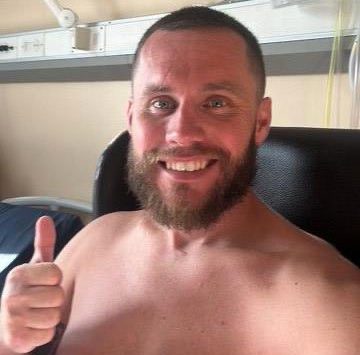
Unexpected Diagnosis: How Severe Stomach Pain Led to the Discovery of a Brain Tumour
Lewis Goodfield, a 37-year-old father of two from Beddau, Wales, had been enduring years of relentless and severe abdominal pain. His health had deteriorated to the point where he had already been hospitalised twice for the debilitating discomfort. In March of last year, his condition reached a critical point when he collapsed in agony, even while already within the A&E department of his local hospital. This third hospital admission, however, would lead to a diagnosis that no one, least of all Lewis, could have ever anticipated: a brain tumour.
Initially, the medical team suspected Lewis had suffered a seizure due to his collapse. But a subsequent CT scan revealed a mass on his brain, a discovery that sent shockwaves through Lewis and his loved ones. “It was a huge shock – not just for me but for friends and family, too. It hit me hard,” Lewis recounted.
In April, Lewis received the official diagnosis: a grade two glioma. This type of brain tumour is known for its slow growth but carries the significant risk of progressing to a faster-growing, higher-grade tumour over time. Ironically, the discovery of this serious neurological condition was entirely serendipitous. Lewis’s severe stomach pains, the very reason for his hospital visits, are believed to be completely unrelated to the brain tumour. “It was a massive shock,” Lewis admitted, recalling the moment he was informed about the mass. “But it wasn’t aggressive.”
A Difficult Decision and an Awake Surgery
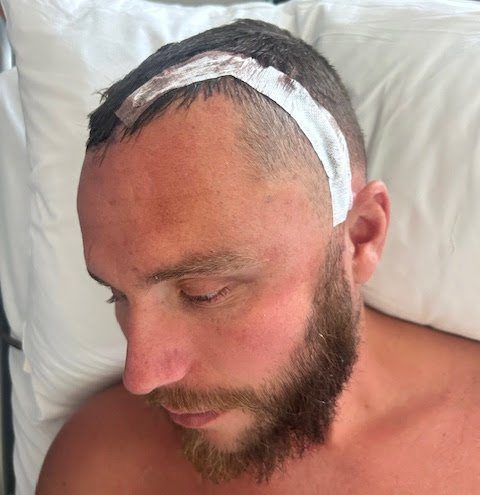
Faced with the news of the brain tumour, Lewis was presented with two primary options: to undergo regular monitoring of the mass or to proceed with surgical removal. He chose the latter, opting for a craniotomy. This complex procedure, performed in July 2025, involves temporarily removing a section of the skull to gain access to the brain. In a remarkable and somewhat unsettling twist, Lewis remained awake for the entirety of the surgery.

“I could hear all the drilling and conversations,” he described, a testament to the extraordinary nature of the operation. “It was really strange and just a lot to take in.” During the procedure, his neurosurgeon even showed him the removed tumour, which was approximately the size of an egg. “My neurosurgeon showed me the tumour in the palm of her hand. I was a bit shocked to see it, it was about the size of an egg. It’s a lot to deal with.”
Fortunately, the operation was a success. The tumour was confirmed to be non-cancerous, and doctors were optimistic that it had been detected early enough.
The Unwavering Support of Family
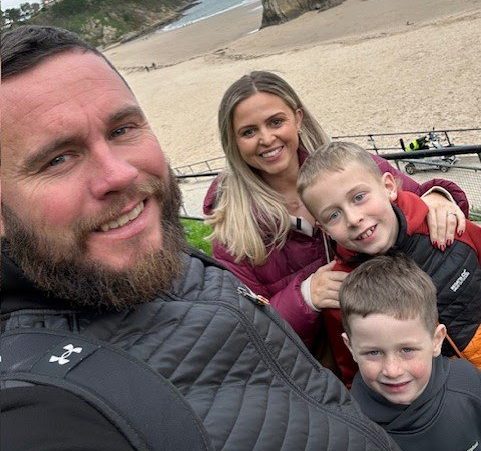
Lewis readily acknowledged the immense role his family, particularly his wife Keeley, played in his recovery. “Keeley has borne the most of this,” he stated emphatically. “She’s had support from family and friends but she’s largely dealt with it all on her own.” He credited Keeley with his ability to remain positive and maintain his daily routines, especially given his inability to drive post-surgery. “I would never had been able to remain positive or stick with my daily tasks if it wasn’t for Keeley. She’s been incredible, especially with me not being able to drive.” The shared experience has deeply impacted them both, with Lewis noting, “The pair of us have really fought and recently the realisation of what we’ve been through has kicked in. We’ve been reflecting on that and it’s really hit home.”
The Lingering Mystery of the Stomach Ailment
Despite the successful removal of the brain tumour, Lewis’s ordeal is far from over. The persistent and debilitating stomach issues continue to plague him. In March 2026, he found himself back in hospital, desperately seeking answers for the ongoing pain. “I can’t live my life like this,” he explained, detailing his exhaustive efforts to find relief. He has tried numerous dietary changes, including abstaining from spicy foods and alcohol for extended periods, but to no avail.
His medical investigations have been extensive. Lewis has undergone approximately ten CT scans, numerous MRI scans, X-rays, a colonoscopy, and two endoscopies, with another endoscopy scheduled for the current week. He is also due to undergo a capsule test, a procedure where a small camera capsule is swallowed to track the digestive system. To date, doctors remain baffled by the cause of his severe abdominal pain. “It’s a bit of a mystery,” Lewis admitted. “One of them said, ‘You might have to live with this’. I said, ‘I’m sorry, I can’t, there’s got to be an answer’.”
Symptoms of a Glioma
Gliomas, like the one Lewis was diagnosed with, can manifest in a variety of ways. Some common symptoms include:
- Persistent Headaches: Often more severe in the mornings.
- Seizures: These can vary significantly in their type and intensity.
- Nausea and Vomiting: Particularly prevalent in the early hours of the day.
- Vision Problems: Such as blurred vision or experiencing double vision (diplopia).
- Cognitive or Personality Changes: Including difficulties with memory and experiencing confusion.
- Weakness or Numbness: Typically affecting one side of the body.
Navigating Life After Brain Surgery
The brain surgery, while life-saving, has also introduced new challenges into Lewis’s life. He now finds busy environments overwhelming and is more sensitive to noise and bright lights than he was previously. His memory function has also been affected, though he reports steady improvement week by week, aided by his supportive family and friends.
Fundraising and Community Support
Undeterred by his personal health battles, Lewis has channeled his energy into raising funds for The Brain Tumour Charity. He has managed to raise over £3,600, even having to postpone a planned fundraising walk, The Twilight Walk, due to his ongoing stomach issues. He shared the importance of the charity with his two children, Jake and Ralph, who were initially unaware of the full extent of his diagnosis.
“I need to be fit enough to do [the walk] but talking about this has been fantastic,” Lewis stated. “I’ve had so many messages of support and people joining the walk – some I only know through a friend of a friend. Some have been affected by similar issues.” Currently, over 60 people have pledged to join Lewis’s fundraising walk, underscoring his determination to see it through despite the persistent abdominal pain. Engaging with others and sharing his story has also been a crucial part of his healing process, helping him to come to terms with everything he has endured. “It’s so good for us to talk things through,” he concluded.