

































Historic Port of Aberdeen Faces Existential Threat from Energy Policies, Warns Scottish Conservative Leader
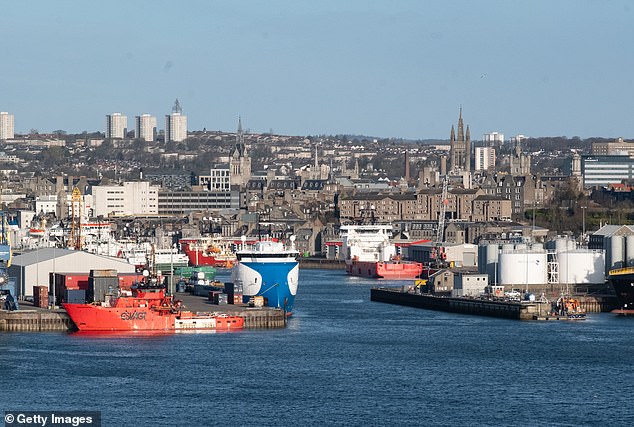
Britain’s oldest continuously operating business, the Port of Aberdeen, a venerable institution with nearly 900 years of history, is facing an unprecedented challenge that threatens its very existence. Russell Findlay, the Scottish Conservative leader, has issued a stark warning that current energy policies championed by the Labour Party and the Scottish National Party (SNP) could prove more detrimental than historical upheavals like the Viking invasions or the devastating bombings of the Luftwaffe.

Mr. Findlay’s concerns were voiced following a tour of the port’s South Harbour facility, accompanied by Kemi Badenoch, the UK Secretary of State for Business and Trade. The visit underscored Ms. Badenoch’s intensified campaign to bolster support for the crucial North Sea oil and gas industry, a sector she argues is vital for both national energy security and alleviating the financial strain on households grappling with soaring energy costs.
“Aberdeen Harbour is the oldest business in Britain, it has been going for almost 900 years,” Mr. Findlay stated emphatically. “It survived the Vikings and the Luftwaffe bombing but there is a very real chance it won’t survive Ed Miliband and John Swinney.”
The historical significance of the Port of Aberdeen cannot be overstated. Established in 1136 by King David I, its enduring legacy is recognised by the Guinness Book of Records as the oldest existing business in the United Kingdom. This remarkable longevity underscores the severity of the current threat.
The tour with Ms. Badenoch came in the wake of her robust call to “get Britain drilling” and her proposals to ease the burden on families by potentially saving them up to £200 per year on energy bills through measures such as removing VAT, the carbon tax, and wind farm subsidies.
During their visit, Ms. Badenoch did not hold back in her criticism of the First Minister, John Swinney. She condemned his stated intention to demand the devolution of energy powers on the very first day of a new term should the SNP secure a majority.
Ms. Badenoch expressed deep scepticism regarding the SNP’s stewardship of further energy powers. “What would they do with those powers? Just tax, tax, tax more but they would not actually allow drilling oil and gas in the North Sea, they would kill what is left of the oil and gas industry,” she declared. “We have seen from the SNP that they are just another Left-wing tax-raising party. That is not what the industry needs.”
She further elaborated on her commitment to dismantling policies perceived as harmful to the sector, specifically targeting the windfall tax on oil and gas profits. Ms. Badenoch argued that this tax is actively “sending business away” and is a significant deterrent to investment in the UK.
“We need to make sure we can drill our own oil and gas in the North Sea, have those licences, scrap the windfall tax and also allow the Government to invest elsewhere,” Ms. Badenoch asserted. “We need to do everything we can to get as much revenue as we can at a time when we are seeing supply shocks. The SNP is not even talking about this.” She concluded by highlighting the strategic importance of the sector, stating, “Our oil and gas industry is an industrial jewel and we should be supporting it.”
Adding to her critique, Ms. Badenoch also labelled Labour’s approach to the oil and gas sector as “completely crazy.”
Meanwhile, during a separate visit to the St Fergus gas terminal in Peterhead, First Minister John Swinney reiterated his position: “I want to begin the journey to independence on day one of the new term with the immediate transfer of powers over our energy.”
The Port of Aberdeen was approached for comment on the developing situation.
The debate surrounding the future of the North Sea oil and gas industry and its impact on established infrastructure like the Port of Aberdeen is set to intensify as the political landscape continues to evolve. The historical resilience of the port stands in stark contrast to the potential fragility it now faces from policy decisions that could fundamentally alter its operational viability. The call for a supportive and pragmatic energy strategy that balances environmental aspirations with economic realities is becoming increasingly urgent.



















