































The Australian sharemarket experienced a significant downturn on Monday, shedding over 100 points in morning trading. The benchmark ASX 200 index slumped by 111.9 points, or 1.31 per cent, to stand at 8404.40 just after midday. This sharp decline follows a tumultuous week for global markets, with Wall Street’s “Magnificent Seven” tech giants – Microsoft, Alphabet, Apple, Meta, Amazon, Nvidia, and Tesla – collectively losing an estimated $US300 billion ($A455 billion) on Friday.

The escalating geopolitical tensions in the Middle East are casting a long shadow over economic prospects, with a particular focus on the impact of rising crude oil prices on inflation. Brent crude has seen a notable surge, climbing 3.4 per cent on Friday to reach $US105.32 per barrel, a substantial increase from approximately $US72.50 just days prior. This upward trajectory in oil prices is fuelling inflation fears across Australia, leading to stark predictions from financial institutions. Commonwealth Bank, for instance, has revised its outlook, now forecasting two additional interest rate hikes for the current year in response to the inflationary pressures.
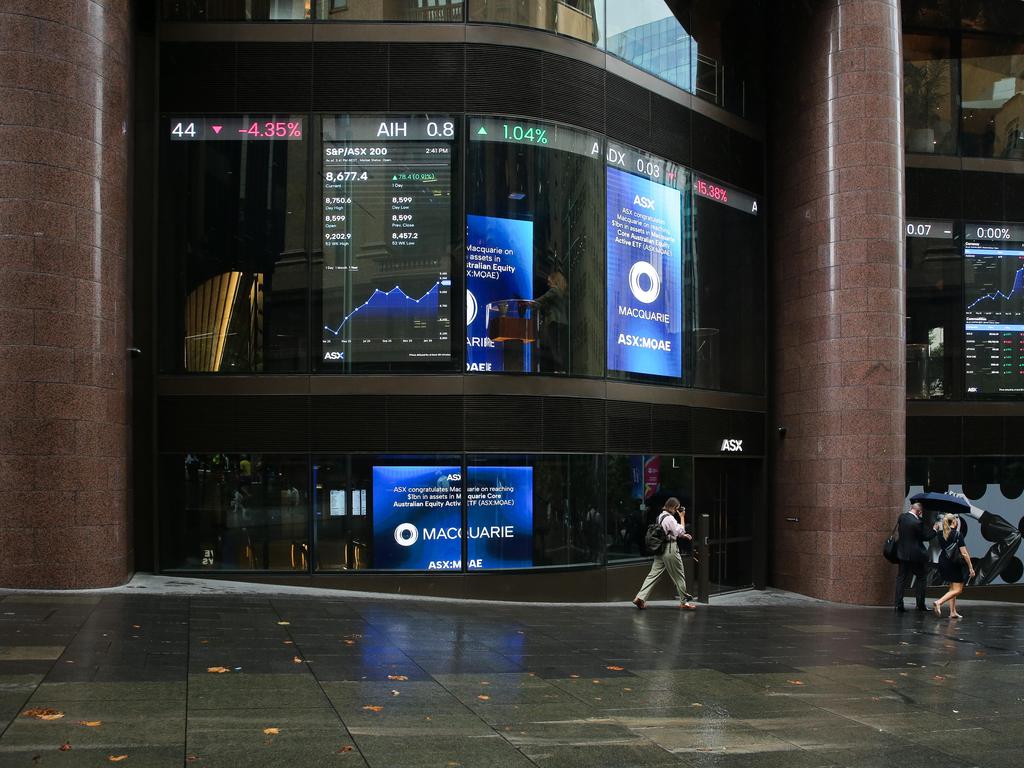
While the ASX 200 had managed a modest weekly gain of 1 per cent by the close of trading on Friday, the broader trend over the past month has been negative, with the index down 7.4 per cent. The recent escalation of conflict, particularly after markets closed on Friday with Yemen’s Houthi rebels initiating strikes against Israel, has heightened concerns. This development poses a direct threat to the vital Bab el-Mandeb Strait, a crucial chokepoint for global commodities shipping.
The potential ramifications of a prolonged conflict in and around Iran are significant for the Australian economy. Financial consultancy Switzer, based in Sydney, has modelled various scenarios. Their analysis suggests that a drawn-out conflict could contribute an additional 5 per cent to Australia’s existing inflation rate.
Economic Impact Scenarios
The severity of the economic fallout hinges on the duration of any potential conflict and the eventual brokering of a ceasefire. Switzer’s modelling outlines two distinct possibilities:
-
Mid-April Ceasefire Scenario:
- In this more optimistic scenario, where a ceasefire is established by mid-April, the impact on Australia’s Gross Domestic Product (GDP) is projected to be a modest fall of 0.02 per cent.
- Consumer prices, however, are expected to rise by 0.6 per cent.
- Analyst George Verikios noted that the primary impact would be concentrated within the energy sector. “Most industries would take a small hit, as the costs of their inputs rise marginally,” he explained. He also pointed out a potential silver lining: “At the same time, however, Australia’s oil and gas extraction would be likely to expand, as higher global prices make domestic production more profitable.”
-
September Ceasefire Scenario:
- A significantly more concerning outlook emerges if a ceasefire is delayed until September.
- Under this prolonged conflict scenario, Australian GDP is predicted to contract by a more substantial 0.16 per cent.
- The impact on consumer prices would be considerably more severe, with an estimated rise of 5.1 per cent.
The current market sentiment underscores the delicate balance of global economic stability, where geopolitical events can swiftly translate into tangible financial consequences for economies worldwide, including Australia. Investors and policymakers will be closely monitoring developments in the Middle East and their subsequent impact on inflation and interest rate trajectories.