

































The Latin Patriarch of Jerusalem, Cardinal Pierbattista Pizzaballa, was reportedly barred from entering the Church of the Holy Sepulchre to celebrate Palm Sunday Mass, an event described by the Latin Patriarchate as a “grave precedent” and a happening that has “not occurred for centuries.”

The incident, which saw both Cardinal Pizzaballa and the Custos of the Holy Land, Father Francesco Ielpo, turned away by Israeli authorities, has drawn widespread condemnation and raised serious concerns about religious freedom and the protection of holy sites. The Latin Patriarchate issued a statement expressing deep disappointment, noting that the church leaders were stopped while proceeding privately, without any ceremonial elements that would constitute a procession. This action, they argued, “disregards the sensibilities of billions of people around the world.”
Security Concerns Cited by Israeli Authorities
Following the incident, the Israeli government released its own statement, explaining that instructions had been issued for all holy sites across all religions prohibiting mass gatherings. This measure, they stated, was a direct response to the perceived risk of Iranian airstrikes in the region. The government cited security concerns as the primary driver behind these restrictions.
Since the US-Israeli strikes on Iran, which reportedly triggered the Iran war on February 28th, Israeli authorities have implemented a ban on large gatherings, impacting places of worship such as synagogues, churches, and mosques.
Israeli President Isaac Herzog later reiterated the government’s stance, emphasizing that the approach was “stemmed from security concerns.” However, President Herzog also reached out to Cardinal Pizzaballa to convey his “great sorrow over this morning’s unfortunate incident.” He reaffirmed Israel’s commitment to “upholding the status quo at the holy sites of Jerusalem.”
International Outcry and Reactions from European Leaders
The barring of the Cardinal from the Church of the Holy Sepulchre has ignited a firestorm of criticism from across Europe and the wider Catholic world.
-
European Union’s Stance: Kaja Kallas, the EU’s foreign policy chief, strongly denounced the incident as a “violation of religious freedom and long-standing protections governing holy sites.” She stressed that “Freedom of worship in Jerusalem must be fully guaranteed, without exception, for all faiths. Jerusalem’s multi-religious character must be protected.”
-
Italian Government’s Response: Italian Prime Minister Giorgia Meloni voiced her disapproval of the Israeli police’s actions, labelling the event “an offence not only to the faithful but to any community that respects religious freedom.” In a separate development, Italy’s Foreign Minister Antonio Tajani announced that he had summoned Israel’s ambassador to discuss the matter.
-
French President’s Condemnation: Emmanuel Macron, the President of France, described the situation as “alarming” and offered his unequivocal support to the Catholic figures involved. He posted on X, stating, “I condemn this decision by the Israeli police, which adds to the alarming proliferation of violations of the status quo of Jerusalem’s Holy Sites.”
Significance of Palm Sunday
Palm Sunday holds profound significance for Christians worldwide. It marks the beginning of Holy Week, commemorating Jesus Christ’s triumphal entry into Jerusalem, an event that occurred just days before his crucifixion and resurrection, as recounted in the Gospels.
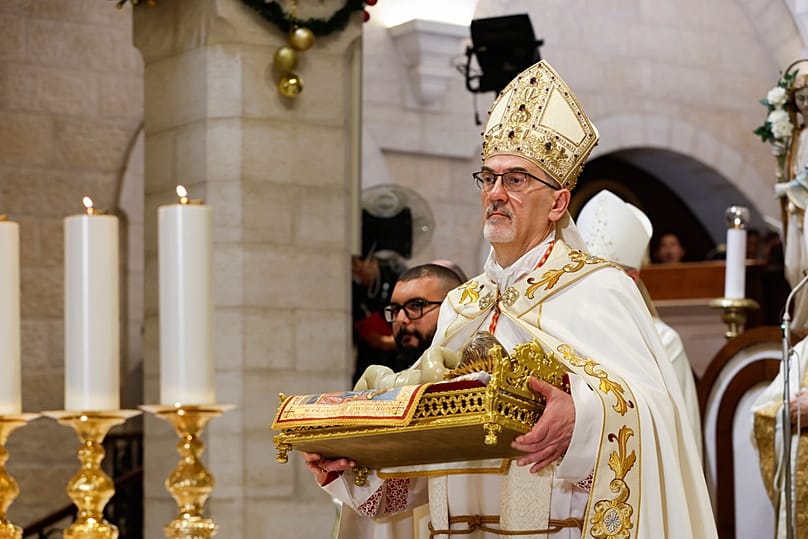
Under the current Israeli restrictions, public gatherings are capped at approximately 50 people.
The Latin Patriarchate of Jerusalem and the Custody of the Holy Land have extended their profound apologies to the Christian faithful globally. They expressed deep sorrow that a prayer on one of the most sacred days in the Christian calendar was prevented in such a manner.



















